The Timeless Appeal of Brown Plaid Seamless Patterns in Modern Design
In the vast landscape of graphic design, textiles, and digital art, few motifs possess the enduring charm and versatility of plaid. While red tartans often dominate popular culture due to their association with heritage and holidays, brown plaid seamless patterns offer a subtler, warmer, and infinitely more adaptable aesthetic. Whether you are a web designer looking for background textures, a fashion illustrator seeking fabric references, or a small business owner creating packaging materials, understanding the nuances of brown plaid is essential.
This guide explores what makes brown plaid unique, why seamless patterns are the industry standard for efficiency, and how high-quality digital assets can elevate your creative projects from amateur to professional.
Understanding the Aesthetic: Why Brown?
Before diving into the technicalities of file formats, it is important to understand the psychological and visual impact of color. Red plaid is bold; blue plaid is cool and distant. Brown plaid, however, strikes a balance that resonates deeply with modern sensibilities. It evokes feelings of warmth, stability, nature, and comfort.
Brown is an earth tone. When used in a plaid structure—a crisscrossed pattern of horizontal and vertical bands in multiple colors—it grounds a design. It suggests:
- Autumnal Comfort: Think of flannel shirts, cozy sweaters, and falling leaves.
- Rustic Elegance: In interior design, brown plaids suggest cabin chic, leather furniture, and wooden accents.
- Vintage Charm: Brown tones often mimic aged paper, old books, and classic tweed fabrics.
For designers, this means brown plaid is not just a pattern; it is a mood setter. It works exceptionally well in branding for coffee shops, artisanal food products, outdoor gear companies, and educational institutions that wish to convey tradition and reliability.
The Power of "Seamless" in Digital Design
You may have encountered terms like "seamless," "tiled," or "repeatable" in asset libraries. What exactly does this mean for your workflow? A seamless pattern is designed so that when it is repeated side-by-side and top-to-bottom, there are no visible lines or breaks where the images meet. This creates the illusion of an infinite surface.
Why Seamless Matters for Efficiency
Imagine you are designing a website background or wrapping a large gift box. If you use a standard image that is only 800 pixels wide, you would either stretch it (causing pixelation) or repeat it manually without alignment (causing ugly seams). With a seamless pattern, the software handles the repetition perfectly.
This is particularly crucial for:
- Web Development: Small seamless files load faster than massive full-screen images while covering any screen size.
- Textile Printing: Fabric printers need precise repeats to ensure a shirt sleeve matches the body seamlessly.
- Print-on-Demand: Artists selling on platforms like Society6 or Redbubble rely on seamless uploads to cover phone cases, mugs, and t-shirts uniformly.
Technical Specifications: What You Get and Why It Counts
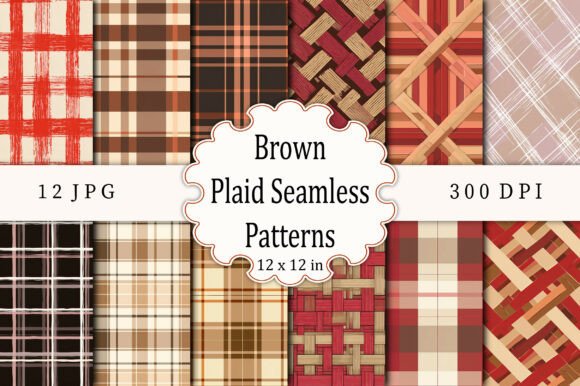
When sourcing digital assets, specifications matter immensely. A common offering in premium design marketplaces includes a curated collection of 12 unique JPG files. But what do these specific metrics—12x12 inches and 300 DPI—actually translate to in real-world application?
High Resolution: The 300 DPI Standard
DPI stands for "Dots Per Inch." In the world of digital screens, we usually talk about PPI (Pixels Per Inch), but for print, 300 DPI is the gold standard. If you download a pattern at 72 DPI (standard web resolution) and try to print it on a large banner or a piece of clothing, it will look blurry and pixelated.
By ensuring your brown plaid patterns are 300 DPI, you guarantee crisp edges and smooth color gradients, even when viewed up close. This is non-negotiable for professional printing.
The 12x12 Inch Format
A 12x12 inch square is a versatile canvas. At 300 DPI, a 12x12 inch image contains 3600 x 3600 pixels. This provides ample data for the pattern details without being so massive that it crashes older computers. It is the perfect middle ground for:
- Creating custom wallpaper samples.
- Designing scrapbooking papers.
- Testing texture overlays in Photoshop before scaling them up.
Uniqueness: 12 Distinct Variations
Why 12 files? Because "plaid" is not a monolith. A good collection offers variety in scale, contrast, and undertone. One file might feature a dark chocolate brown with cream checks, suitable for a masculine corporate logo. Another might have a lighter tan with hints of olive green, perfect for a botanical blog header. Having 12 unique options allows you to A/B test designs or maintain brand consistency across different product lines without using the same texture twice.
Practical Applications in Creative Industries
So, you have acquired your brown plaid seamless patterns. How do you use them? Here are three practical scenarios where these assets shine.
1. Interior Design Mockups
Interior designers often struggle to visualize how a fabric will look in a room. By applying a brown plaid seamless pattern as a texture map in 3D rendering software, they can instantly simulate upholstery for chairs, curtains, or throw pillows. The warm tones of brown plaid can soften a stark, modern room, adding a layer of inviting coziness.
2. Packaging and Branding
Consider a local roastery selling organic coffee beans. They want their packaging to feel artisanal and grounded. A brown plaid background on a kraft-paper-style label immediately communicates "natural" and "handcrafted." Because the pattern is seamless, it wraps around boxes and bags flawlessly, creating a premium unboxing experience.
3. Educational Materials
Teachers and curriculum developers are increasingly using digital resources. A brown plaid background can serve as a neutral, non-distracting backdrop for worksheets, certificates, or classroom decorations. Unlike bright primary colors, which can overstimulate young learners, the muted tones of brown plaid promote focus and calm.
Common Misconceptions About Plaid
There is a prevalent assumption that plaid is strictly a winter or holiday motif. While it is true that red and green plaids peak during December, brown plaid transcends seasonal boundaries. It is a year-round staple. Furthermore, some beginners believe that complex patterns are difficult to work with. In reality, because brown plaid relies on geometric regularity, it is one of the easiest patterns to align and manipulate in design software like Adobe Illustrator or Canva.
Another misconception is that digital patterns cannot look realistic. With high-resolution 300 DPI files, you can apply noise filters or grain overlays to mimic the texture of woven wool or cotton, bridging the gap between digital vector art and tactile fabric.
How to Integrate These Assets Into Your Workflow
To get the most out of your 12 unique JPG files, follow these best practices:
- Check Your Canvas Size: Ensure your project document is set to 300 DPI before importing the images.
- Use Blending Modes: Don’t just paste the image flatly. Try setting the plaid layer to "Multiply" or "Overlay" in Photoshop to let underlying colors show through, creating depth.
- Scale Appropriately: If a pattern looks too busy, scale it up. If it lacks detail, scale it down. The 12x12 source file gives you the flexibility to resize without losing quality.
- Color Grading: Since brown is a neutral base, you can easily adjust the hue/saturation to shift the plaid toward orange (for autumn vibes) or gray (for industrial/modern vibes).
Conclusion
Brown plaid seamless patterns are more than just decorative elements; they are foundational tools for creating atmosphere and texture in design. From their warm, earthy appeal to their technical utility in high-resolution printing, they offer a blend of aesthetics and function that serves creators across industries.
By investing in a high-quality collection—featuring 12 unique, high-resolution, properly tiled files—you equip yourself with the resources to create professional, cohesive, and visually engaging work. Whether you are designing a website, printing fabric, or crafting digital art, the timeless elegance of brown plaid is waiting to add depth to your next project.
Follow to discover more awesome artwork and expand your creative toolkit with premium design resources.
Thank you.