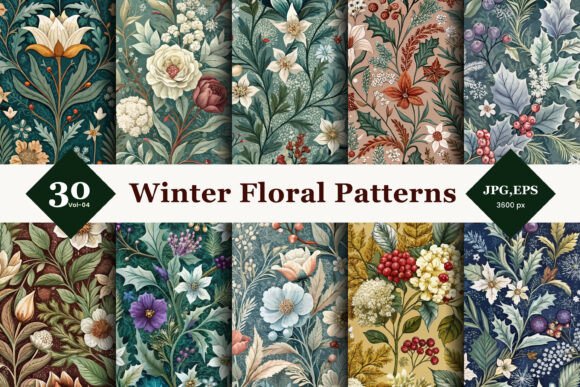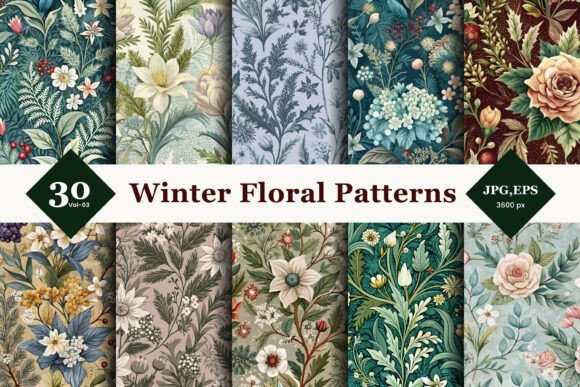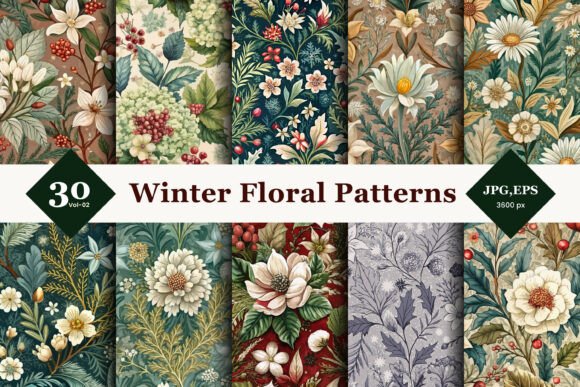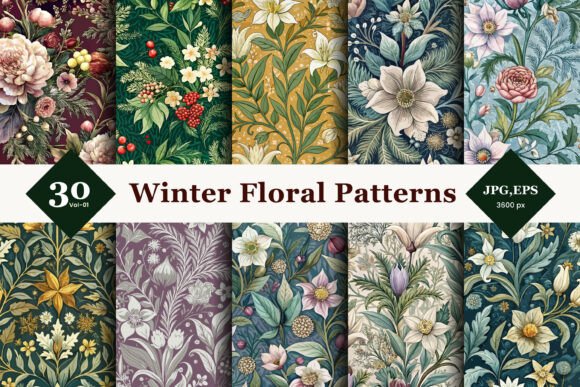
Winter Floral Seamless Patterns 06
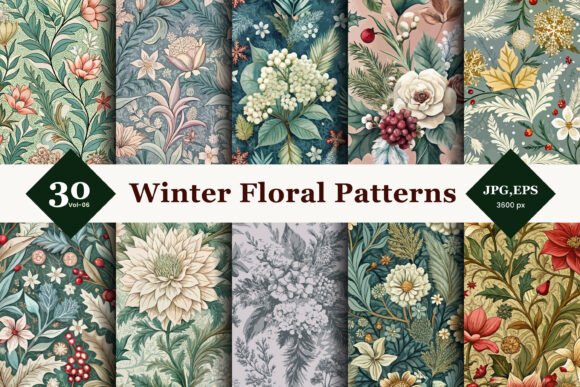
Creating a cohesive visual identity for seasonal projects often feels like walking through a minefield of mismatched aesthetics. You want that crisp, elegant winter vibe without the design looking cluttered or amateurish. This is where Winter Floral Seamless Patterns 06 steps in as a reliable solution. Designed to immerse your projects in winter magic, this collection offers lush botanicals, frosty foliage, and festive berry accents that bring a touch of seasonal elegance to any medium.
Whether you are a small business owner preparing holiday packaging, a blogger designing festive newsletters, or a hobbyist working on scrapbooking layouts, having access to high-quality, versatile patterns is essential. These designs are not just decorative; they are functional assets that save time and elevate the perceived value of your work. However, simply downloading a pattern pack isn’t enough. To get professional-quality results, you need to understand how to leverage these files correctly and avoid common pitfalls that can ruin even the most beautiful artwork.
Understanding the Format Advantage
One of the first things designers overlook when evaluating pattern packs is file format versatility. Many users jump straight into using JPG files because they are easy to open, but this approach limits their creative potential. Winter Floral Seamless Patterns 06 distinguishes itself by offering both high-resolution JPGs and editable EPS vector files. Understanding the difference between these two is critical for achieving the best outcome.
JPG files are raster images. They are perfect for quick previews, web graphics, and standard print jobs where the size won’t change drastically. With 300 DPI resolution, these files ensure sharpness for digital screens and standard printing needs. However, if you attempt to scale a JPG up significantly—for instance, turning a small card design into a large banner—you will notice pixelation. The edges become jagged, and the detail softens, which instantly signals a lack of professionalism.
This is where the included EPS vector files shine. Vectors are mathematical representations of shapes, meaning they can be resized infinitely without losing quality. If you are creating custom textiles, large-scale home décor items, or signage, you must use the EPS files. By editing in software like Adobe Illustrator or Affinity Designer, you can adjust colors to match your brand palette, resize elements to fit specific dimensions, and integrate the patterns seamlessly into larger compositions. Failing to utilize the vector component means you are leaving significant creative flexibility on the table.
Common Mistakes in Application
Even with superior assets, the final result depends entirely on execution. A frequent error among beginners is ignoring the "seamless" nature of the pattern. When applying a seamless pattern, the tile must repeat perfectly. If you place the pattern image directly onto a canvas without tiling it correctly, you will see visible seams or gaps where the tiles meet. This breaks the immersion and makes the design look unfinished.
To avoid this, always use the pattern fill function in your design software rather than dragging and dropping a single image. In programs like Photoshop, Illustrator, or Canva (using third-party plugins or manual tiling techniques), set the document size to be a multiple of the pattern’s tile size. For example, if your pattern tile is 500x500 pixels, create a canvas that is 1000x1000 or 2000x2000 pixels. This ensures the repetition is mathematically precise and invisible to the naked eye.
Another oversight involves color management. Winter themes often rely on cool tones—whites, blues, silvers—but they also feature warm accents like red berries or gold trim. A common mistake is allowing the background color to clash with the pattern’s highlights. Before applying the pattern, check the hex codes of the berries and foliage against your chosen background. If you are printing, remember that screen colors (RGB) do not always translate perfectly to print (CMYK). Always preview your design in CMYK mode before sending it to the printer to avoid unexpected shifts in the vibrancy of the frosty foliage.
Evaluating Versatility for Your Specific Project
Not every pattern works for every project. While Winter Floral Seamless Patterns 06 is described as versatile, its dense botanical details might overwhelm a minimalist stationery design. Conversely, the same patterns might provide the perfect focal point for a busy scrapbook page or a cozy sweater knit.
Consider the density of the pattern. Lush botanicals create a rich texture that demands negative space around them. If you are designing greeting cards, leave ample room for text. Do not crowd the message with intricate berry accents. Instead, use the pattern as a border or a subtle background layer with low opacity. This technique allows the text to remain legible while still conveying the festive spirit.
For textile applications, such as wrapping paper or fabric prints, the scale matters immensely. A pattern that looks delicate on a phone screen may appear chaotic when printed on a yard of fabric. Use the EPS files to test different scales. Zoom out to view the pattern at actual print size. If the individual flowers or berries become indistinguishable blobs, the pattern is too detailed for that scale. Adjusting the vector elements allows you to simplify or enlarge components to suit the medium.
Maximizing Value Through Proper Usage
Investing in a premium pattern pack is only the first step. To truly maximize the value of Winter Floral Seamless Patterns 06, treat these files as a starting point for customization. Professional designers rarely use stock assets exactly as provided. They tweak them to fit their unique style.
Start by experimenting with blending modes. Overlaying the pattern on a solid color background using "Multiply" or "Overlay" modes can create depth and texture that flat images lack. Try placing the pattern behind a semi-transparent white shape to create a frosted glass effect, which pairs beautifully with the winter theme. These small adjustments demonstrate skill and attention to detail, setting your work apart from generic templates.
Additionally, consider the lifecycle of your designs. Digital graphics have a short shelf life, but physical products last longer. If you are producing merchandise, ensure your files are organized and backed up. The instant download convenience is great for speed, but long-term accessibility is key. Keep your EPS files in a dedicated folder structure labeled by year and project type. This organization saves hours of frustration when you return to a project months later.
Final Checks Before Launch
Before publishing your design or sending it to print, run through a final checklist:
- Resolution Check: Ensure all raster elements are at least 300 DPI for print.
- Vector Integrity: Verify that all text is converted to outlines and vectors are embedded.
- Seam Test: Scroll horizontally and vertically across your design to confirm no visible seams exist.
- Color Proof: Print a small sample to check for color accuracy, especially with whites and pastels.
By avoiding these common errors and fully utilizing the dual-format advantage of Winter Floral Seamless Patterns 06, you can create winter-inspired designs that are not only visually stunning but also technically sound. Whether you are crafting digital content or physical goods, these patterns provide the elegant foundation you need to succeed. Take the time to learn the tools, respect the formats, and let your creativity guide the application. The result will be a polished, professional presentation that captures the true magic of the season.